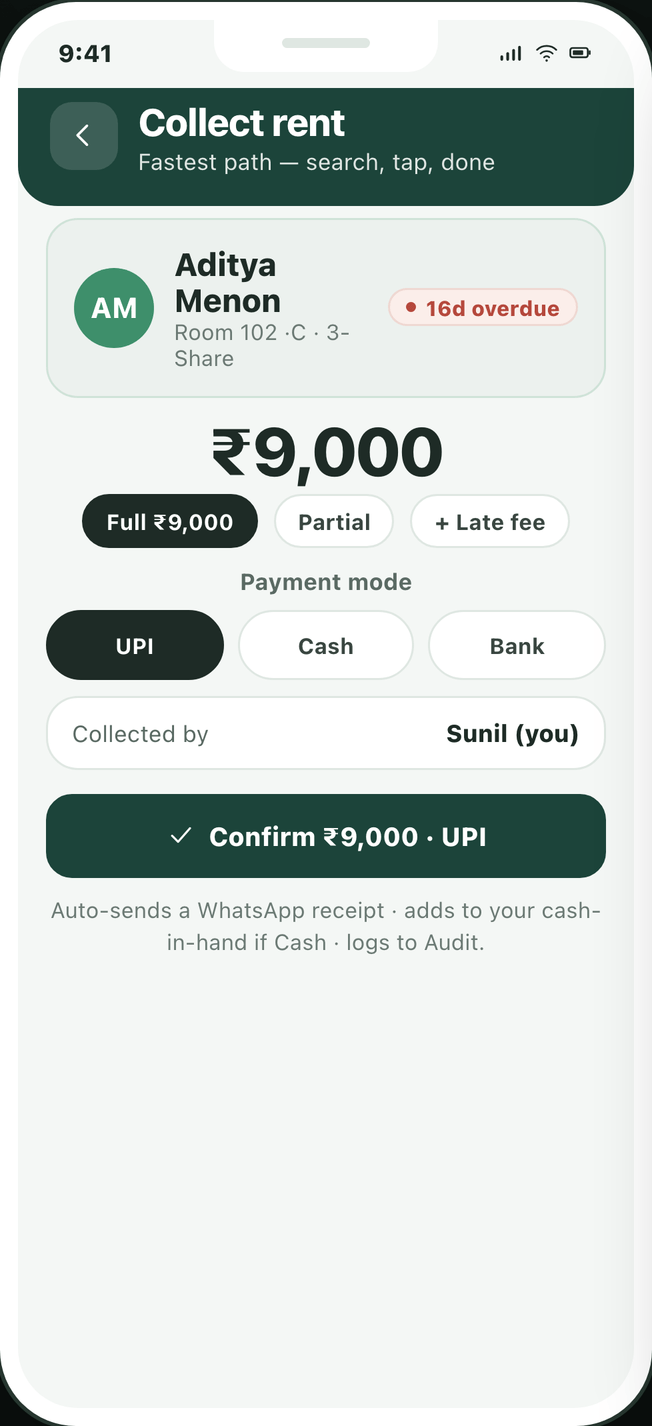
Two taps, and the receipt sends itself
Open a resident, and the amount due is already there. Choose full, a partial amount, or add a late fee. Pick UPI, cash or bank. Confirm. That is the collection — no separate receipt to write, no ledger line to remember, no message to compose.
The moment you confirm, a receipt lands in the resident’s WhatsApp with the amount, the date and the balance that remains. The resident stops asking whether the payment “went through”, because they are holding the proof. Ninety-eight percent of those messages are delivered — the property this was built in measures it from Meta’s own delivery receipts.
Every rupee of cash has a collector’s name on it
When a staff member takes cash, it is recorded against them and added to their cash-in-hand — a running total of money they are holding but have not yet handed over. At any moment you can see who is carrying how much. When they hand it over, you clear it, and the trail shows the handover.
This is the reconciliation gap closed. The difference between what was collected and what was recorded is exactly where cash quietly disappears, and a notebook cannot close it because the notebook is written by the same person holding the cash. Here the record is made at the point of collection, on the collector’s own login, and it cannot be edited away afterwards.
The overdue list sorts itself
Outstanding rent is split into ageing buckets — 0–15, 16–30, 31–60 and 60-plus days — so a bill three days late and a bill two months late are not the same colour on the same list. Filters cut the list to overdue, partial, due or paid. Days sales outstanding is tracked across the property, so “are we collecting faster or slower than last month” is a number, not a feeling.
A bulk WhatsApp reminder goes to a filtered set in one action — the fourteen people who are actually overdue, not a hundred-person blast that trains everyone to ignore you. The reminder is a utility message, so inside an open reply window it costs nothing, and a resident who replies has started a free conversation.
Partial payments and late fees are first-class
A resident who pays half is a normal event in a PG, not an error to work around. A partial payment records the amount, leaves the balance outstanding in the right ageing bucket, and the next reminder reflects it. A late fee is added at the point of collection and shows on the ledger and the receipt, so there is no argument later about whether it was charged.
Deposits are tracked separately — held per resident, split into refundable and non-refundable, and settled at move-out against any dues. When someone leaves, the deposit maths is already done and pointing at a record, which is what turns a move-out dispute into a two-minute conversation.