Photograph the bill, route it through approval
An expense starts as a photo of the bill, categorised on the spot. From there it routes through approval, so a staff member’s claim has a trail — a bill, a category, an approver — instead of a WhatsApp message you half-remember agreeing to. Spend sits against a budget per category, and operating spend is separated from capital spend, so “we are over on groceries” and “we bought three new beds” are not the same line.
This matters most with the people you half-trust. An approval step is not about suspicion; it is about making the honest case easy to prove and the dishonest one hard to hide.
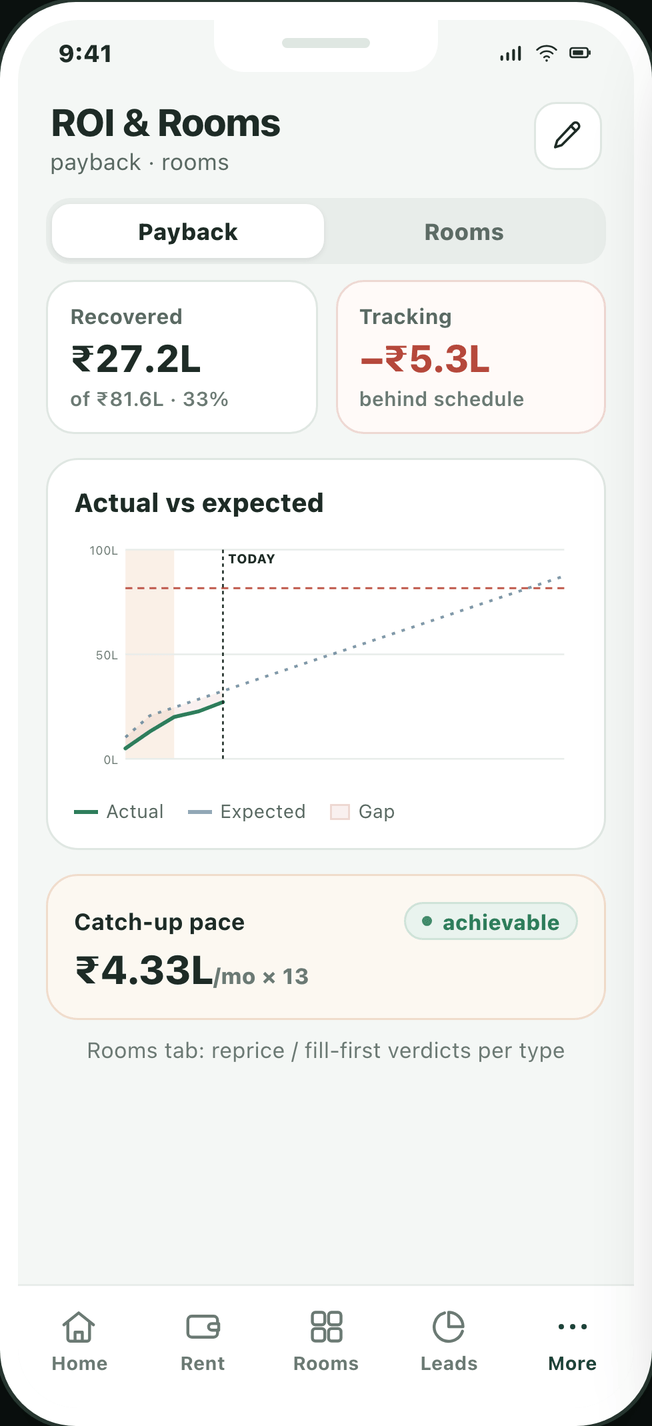
Payback per room type, against what you expected
Every room type has a cost to fit out and a rent it earns, and the only question that matters is whether the second is paying back the first on schedule. PGManage tracks the recovery curve per room type — actual against expected — and shows the catch-up pace when it falls behind. The verdict is plain: reprice this type, or fill it first.
This is the number that ends the pricing-by-hunch cycle. When you can see that the three-sharing rooms pay back in eleven months and the premium singles in twenty-six, the next room you fit out is priced on evidence, and the next one you build is a type you already know earns.
Every action is in the audit log, before and after
Payments, residents, expenses — every change is written to the audit log with the value before and the value after, and sensitive actions are flagged. If a payment was edited, you can see what it was, what it became, and who did it. A deleted record is not gone; it can be restored from the log.
For a business run partly by staff, this is the safety floor. It means a mistake is recoverable and a manipulation is visible, and both are true without anyone having to police the system by hand.
The resident app quietly takes work off you
The money side is lighter when residents self-serve, so the resident app is part of the control story, not a separate product. Residents see their own rent and receipts, pay by UPI, and raise requests that land in a queue instead of your personal chat. Fewer inbound messages means fewer things collected, promised or logged in a WhatsApp thread that no ledger ever sees.
Put together, the money side answers the questions a PG owner cannot usually answer: where did it go, who approved it, which room made it, and can I prove any of it. The answer, in each case, is a record.